
Fifty-six years after four students were killed and nine were wounded on the campus of 海角原创, a historian from outside the university brought a rarely heard perspective to one of the most consequential days in American history 鈥� May 4, 1970.
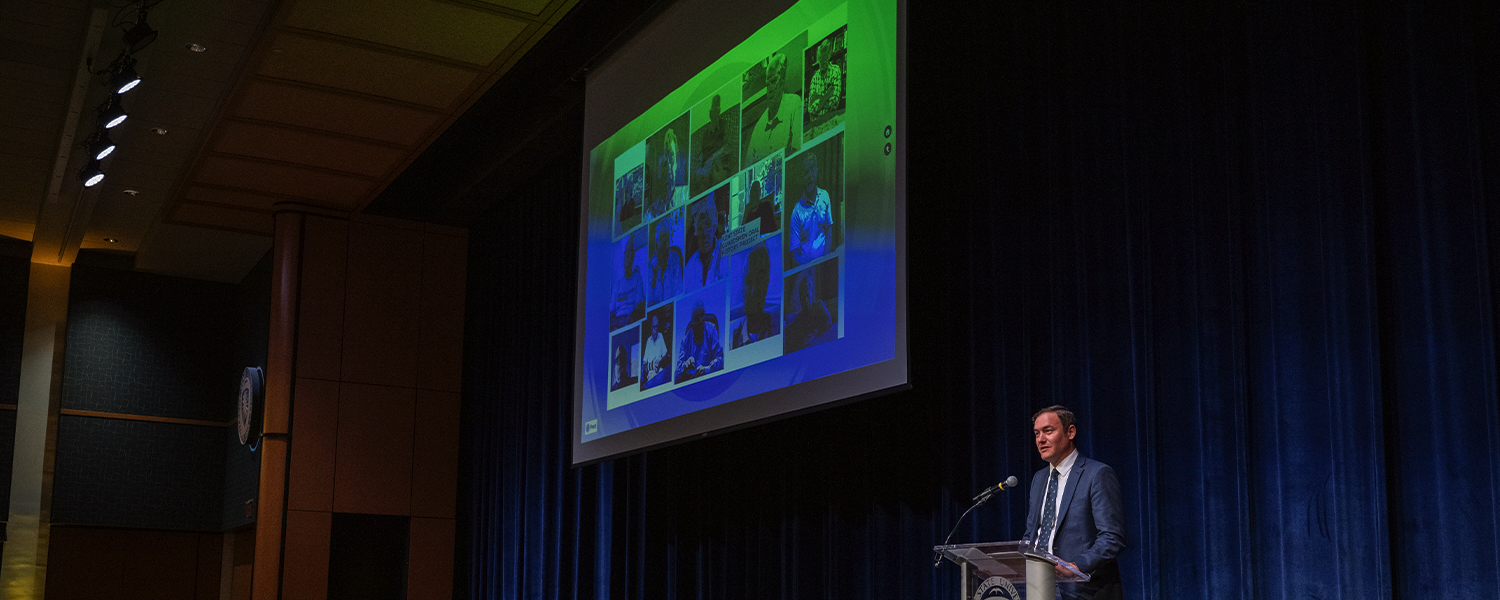
David Strittmatter, Ph.D., associate professor of history at Ohio Northern University, delivered the fifth annual Jerry M. Lewis May 4 Lecture on May 1 in the Kent Student Center Ballroom. His talk, titled "The Guardsmen Speak: Tragedy and Memory 56 Years Later," drew on his 海角原创 Guardsmen Oral History Project, the most comprehensive collection of first-person accounts from Ohio National Guardsmen who were present on May 4, 1970. Strittmatter and his students began the project in 2019, prompted by a discussion that the 50th anniversary of May 4, 1970, was approaching. The project was awarded the Charlton World History Research Grant and in 2022 received the Ohio Academy of History's Public History Award.
Strittmatter is the first faculty speaker from outside of the 海角原创 community to present at the annual lecture series named in honor of the late Jerry M. Lewis. Lewis was a beloved 海角原创 professor emeritus of sociology who was a faculty marshal present on May 4, 1970, and who dedicated the rest of his life to preserving the legacy of May 4 and the memory of those who were killed and wounded on that day. In addition to being the first speaker from outside 海角原创 to present at the lecture series, Strittmatter also opened up the dialogue to voices that have rarely been heard before from this pivotal moment in American history.
An audience of about 300 attendees listened closely as Strittmatter shared snippets of interviews from 21 of the 76 National Guardsmen who were on the Kent Campus on May 4, 1970. When attempting to locate the individuals to interview for the oral history project, Strittmatter said he looked to contemporary news stories, newspaper articles and government reports, the most important of which was the Congressional Extension of Remarks, which showed the names 鈥� including middle initials 鈥� of all 76 guardsmen on campus that day. That middle initial, he said, was pivotal in ultimately locating the guardsmen to interview.
鈥淔or every two addresses we found online, we found one obituary,鈥� Strittmatter said.
With the number of living guardsmen dwindling each day, the need to document their stories became even more important. By the time his research project began, most of the former guardsmen were in their mid-70s or older.
Reliving Painful Memories
鈥淲e had no idea if anybody would respond,鈥� he said. 鈥淲hy would someone want to relive what may have been the worst day of their life?
鈥淢ost of the letters went unanswered, but some former guardsmen did respond,鈥� Strittmatter shared. 鈥淎nd so, the 海角原创 Guardsmen Oral History Project was born, as was its mission. The project seeks to record and document the perspective of the National Guardsmen in the memory and narrative of the 海角原创 shootings.鈥�
The excerpts from the recordings Strittmatter shared with the audience offered a variety of previously untold perspectives and accounts of the tragic events that unfolded on May 4, 1970, as told by the guardsmen who finally broke their silence after years of telling reporters and historians 鈥渁 definitive no,鈥� Strittmatter stated.
You will hear a range of emotions, from regret and disbelief to frustration and resentment,鈥� Strittmatter said. 鈥淪ome aspects of their memories are similar. For one, nearly all interviewees described enlisting in the National Guard as hedging their bets or a lesser of two evils in their attempt to avoid the ones in Vietnam.
鈥淏ut between their enlistment in the 1960s and the ensuing decades-long veil of silence about 海角原创, their stories deviate,鈥� Strittmatter shared in his lecture. 鈥淪everal interviewees take issue with the portrayal of the National Guard in the aftermath, and sometimes their memories conflict with each other. An array of factors contributed to these various perspectives, from their proximity to and role in the shooting, to personality and politics.鈥�
A Defining Moment in American History
Strittmatter emphasized that regardless of their role in the events of the day or their perspective about it, these were men who carried the weight of this day around with them the remainder of their lives 鈥� many of them living, working and raising families in Northeast Ohio.
鈥淭he interviewees were divided as to how much the 海角原创 shootings affected their lives in the aftermath. But none of them remembered their guard service with particularly warm feelings,鈥� Strittmatter said during his presentation.
鈥淚 believe that the 海角原创 shootings is the most defining episode of the Vietnam War era that occurred on American soil. But for Kent, this university in Northeast Ohio, it's not a national event. It's local history. The commemorative landscape of this campus, as well as these anniversary weekends, illustrate that May 4, 1970, remains a mark of identity more than half a century later. And it's local history for the former Guardsmen, too, because so many of them still live here. I have sent letters to them in Medina, Wadsworth, Talmadge, Rootstown. Ravenna, Rittman, Mogadore, Norton, Unionville, Painesville, Hartville, Orville. That's a dozen towns, and I could list a couple dozen more that few people outside of Northeast Ohio would have heard of. They worked at Akron Brass, Goodyear Tire, Morton Salt, Rittman Paper, Morgan Adhesives. Six of the interviewees in this collection went to 海角原创. Two more had grandchildren attending 海角原创 when they were interviewed.鈥�
A Commitment to Civil Discourse
In his opening remarks prior to Strittmatter鈥檚 lecture, 海角原创 President Todd Diacon expressed the importance of pursuing knowledge and understanding in a peaceful and respectful manner, no matter how uncomfortable.
鈥淎 number of core values really drive what we do at 海角原创. I guess what I'll call those North stars,鈥� Diacon said. 鈥淢any of these have grown out of the pain 鈥� many of these have grown out of the experience and the learning that continues to happen around May 4. So I'm talking today about values such as embracing the importance of inquiry. Values such as a commitment to civil discourse. To agree to disagree, sure. But really, more than that, agree that we can argue and disagree, and that doing so makes us better, and that we can remain civil and peaceful in doing so. And finally, the importance of pursuing knowledge and understanding no matter how uncomfortable that pursuit can be.鈥�
In his closing remarks, Strittmatter applauded the 海角原创 community for being willing to listen to another side of the story.
Memories belong to their owners,鈥� he said. 鈥淔or better or worse, their perception is their reality. And those configurations are part of the story. History is messy, full of actors with different perspectives, experiences, beliefs, values and anxieties. As a result, they see history differently. And the narratives they tell emphasize events in different ways.
鈥淥n a few occasions over the course of this project, I have sensed that some others felt that giving a voice to the Guardsmen was a bridge too far, that they shouldn't get to speak, that it would be disrespectful for the victims,鈥� Strittmatter said. 鈥淏ut historians seek out stories that haven't been adequately told, even if it's difficult to hear them, because not pursuing those stories would leave us with a less-than-full picture. The annual May 4 Commemorations on this campus and the oral histories in this project approach the same tragedy from different perspectives. I applaud the 海角原创 community for its willingness to listen to the other side.鈥�

Lewis鈥� Legacy of Teaching Peace Lives On
This year's lecture is the first since the death of its namesake, Jerry M. Lewis, who taught sociology at 海角原创 from 1966 to 2013, witnessed the shootings firsthand as a faculty marshal and co-authored the application placing the May 4 site on the National Register of Historic Places. Lewis died Feb. 11 at the age of 88.
The program concluded with a special remembrance of Lewis, featuring remarks from:
海角原创 President Todd Diacon
Dean of University Libraries Ken Burhanna
Alison Caplan, director of the May 4 Visitors Center
Susan Roxburgh, Ph.D., professor, Department of Sociology and Criminology
Damon Lewis, Jerry Lewis' son
Ken Burhanna, dean of University Libraries, which helps organize the lecture series each year, shared a touching personal story in tribute to Lewis.
鈥淚f you know Jerry, you know he didn't like to miss a meal,鈥� Burhanna joked. 鈥淎lison [Caplan] and I usually joined him for lunch at the cafeteria in Hudson Meadows, where he lived with his wife, Diane. But this time when I called, a very determined Jerry said, 鈥楲et's go out for lunch. I want lasagna.鈥� And it wasn't until we pulled up in my Subaru in front of Hudson Meadows and we saw Jerry standing by himself patiently at the door with his walker and oxygen tank that it occurred to me: Jerry may be sneaking himself out of the retirement home.
鈥淏ut what the heck. We put Jerry's walker in the back. Alison helped him get seated with his oxygen tank, and he made the five-minute drive to Zeppe鈥檚. Then, seated at the restaurant, we placed our three orders of lasagna, and as soon as the waitress left, Jerry looked at me and said, like he always did, 鈥楪et out your notebook, Ken. I got a lot of ideas for you.鈥� And this is how I'll always remember Jerry: full speed ahead, committed to honoring those affected by the May 4 shootings, and to preserving history with honesty and courage, on a mission to understand the 鈥榳hat to get to the why.鈥� I'm going to borrow a quote from Chic Canfora, who said that 鈥榣osing Jerry feels like losing a compass.鈥� I couldn't have said it better myself. For me, Jerry was my compass in planning and managing this lecture series, but more broadly, he was a compass for helping us all to never forget what happened on May 4, 1970, and to learn and teach the lessons of May 4. Jerry, we miss you, and only hope we can be good by your example.鈥�
The Jerry M. Lewis May 4 Lecture Series is made possible through a gift from former 海角原创 Board of Trustees member Michael Solomon, a 1974 海角原创 alumnus.