
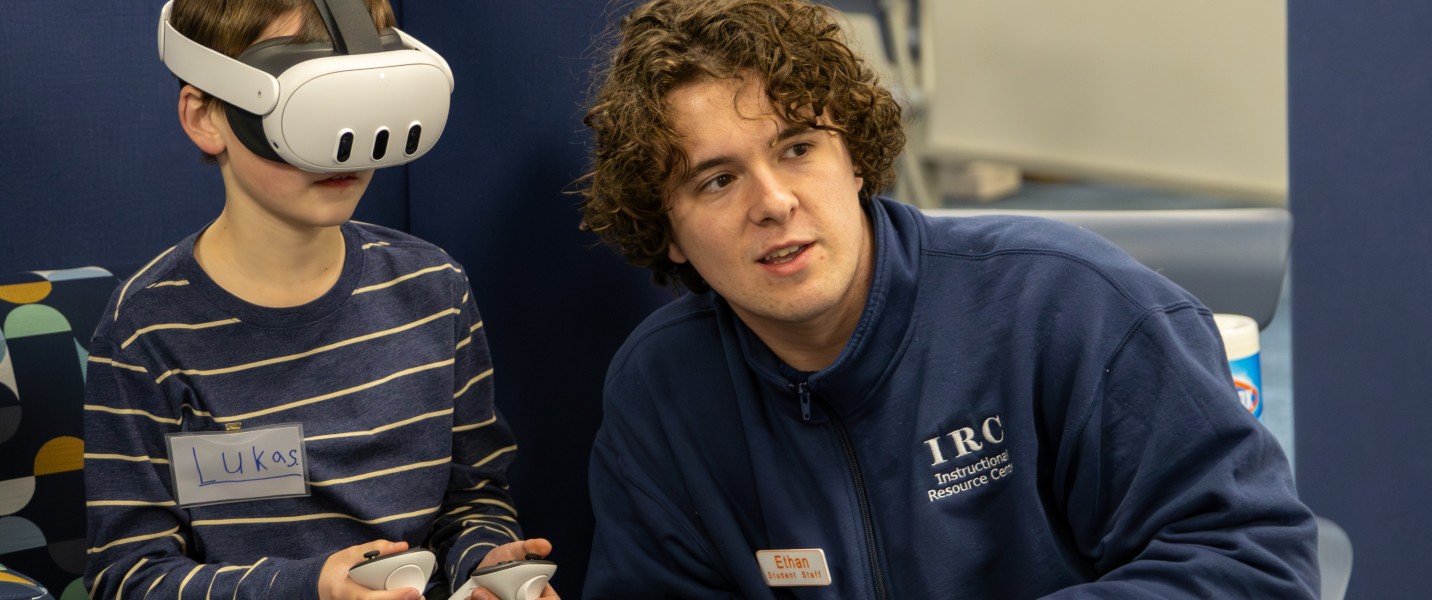
When it first opened in the mid-1960s, the Instructional Resource Center (IRC) boasted thousands of visitors annually, making it one of the most popular spots for education majors and faculty at 海角原创.
The first visitors to 海角原创鈥檚 IRC came for instruction, tours, and to access the assortment of accouterments: filmstrips, catalogs, textbooks and the like, materials designed to aid class assignments and prepare students to teach.
IRCs are crucial hubs that enhance education by providing specialized, curated, and free-of-charge materials to educators and students, including adaptive technology and curriculum-linked tools that support student achievement, promote professional development and assist with adapting teaching strategies to match different learning styles.
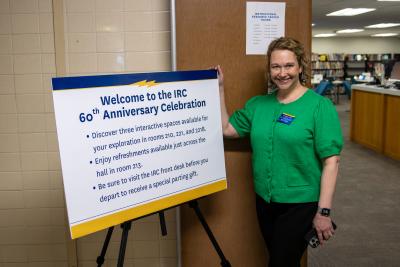
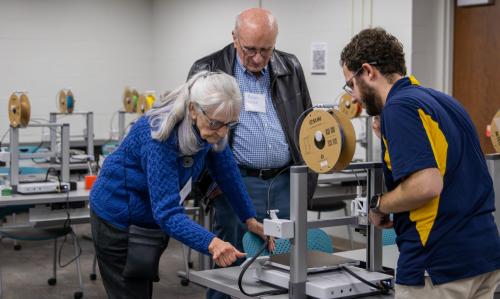
Recently, the center hosted a new mix of faculty, staff, students, former employees and community leaders who gathered to celebrate its 60th anniversary with tours, displays, and demonstrations of the latest emerging technologies like extended reality and robotics. Those who were interested also got to try their hand with cutting-edge equipment like 3D printers.
The IRC was originally set up to serve education faculty and students in three major areas: the Curriculum Materials Library, the Equipment Training Laboratory, and the Materials Production Laboratory. The center was focused almost exclusively on supporting education faculty and students with physical teaching materials but has since morphed into a broader college innovation and service hub.
鈥淭he original focus was hands-on support for education students, such as lesson planning, resources, physical instructional materials, and equipment training,鈥� said Julee Henry, Ph.D., director of Technology and Instructional Resources. 鈥淭hose users still represent a strong core user base, particularly for lesson plans, classroom preparation, and instructional design.鈥�
Since its inception, the center has changed dramatically, adding a range of entirely new services:
- The Learning Innovations Lab diverges from the traditional makerspace model to focus specifically on emerging technology
- The Learning Innovations 3D Print Lab offers cutting-edge 3D printing technologies for students, faculty and staff and supports creative, hands-on work and interdisciplinary collaboration across 海角原创.
- Workshops and professional development
- Printing, production services
- Fingerprinting and background checks
- Technology training
- Library, including curriculum materials
Additionally, the user base has broadened.
鈥淣ow we鈥檙e seeing all majors, nursing and health sciences students for background checks and fingerprinting, business and STEM students using 3D printing, and general studies students for workshops or production services,鈥� said Henry. 鈥淚t鈥檚 no longer exclusively education-focused, though education students remain frequent users due to recurring assignments.鈥�
But the more things change, the more they stay the same.
According to Henry, repeat academic users likely still form the backbone of traffic. 鈥淏ased on comparable university resource centers and the expansion of services beyond education, we see 4,000鈥�7,000 visitors annually, possibly more depending on workshop offerings, peak academic cycles, and lab usage,鈥� she said.

鈥淭he center is very interactive, and it鈥檚 been keeping up with the technological changes, which is so important and a challenge in this field,鈥� said EHHS Professor Emeritus Dale Cook, who, as a summit professor created 海角原创鈥檚 AT&T Classroom and, subsequently, the Research Center for Education Technology. 鈥淭o prepare teachers to be in classrooms with kids who are already using a lot of these things, the faculty and students need to understand and appreciate the importance of learning how to use technology in the classroom. It鈥檚 important so they can get hands-on experience here before they go to a school and find it there and don鈥檛 know what to do,鈥� said Cook, who also served as the associate dean of technology.
What does the immediate future hold?
Henry forecasts an expansion of existing services and increased collaboration across the university, coupled with hybrid/virtual workshops, AI and emerging educational technology integration, and a continued shift toward innovation-based learning environments.
鈥淚f trends continue, the IRC will evolve into a leading emerging technology center, blending instructional support, technology, and professional preparation for students, faculty, and staff across the college, university, and the broader community.鈥�