

I鈥檓 Stuart Klein, an major in the Honors College at 海角原创, Class of 2027. When I was choosing colleges, I wanted more than lectures. I wanted a place where I could build real things, test ideas, and be part of a community that knows my name. That鈥檚 what I found at the College of Aeronautics & Engineering (CAE).

A huge part of my story is the . I鈥檝e helped lead across the team, from working with the propulsion subsection, helping with payload, and serving as an officer for the last two years.
Learning to write checklists, manage risks, and lead a crew on a countdown taught me the importance of accountability and the ability to remain calm under pressure. It鈥檚 engineering that must work the first time; no simulations can replace that feeling when your rocket clears the rail.
Research has also been a defining experience.
In the Fuel Cell & Sustainability Lab under Dr. Yanhai Du, I compared PEM and solid-oxide fuel cells, looking at performance, efficiency, and cost. Presenting this work across campus sharpened how I collect data, interpret results, and communicate complex ideas. One of my proudest moments at 海角原创 was earning first place for my research.
My hands-on mindset carried into digital engineering, too. With the Digital Engineering Design Center (DEDC), I worked on our indoor autonomous delivery robot. We used model-based systems engineering to build clear requirements, then tied them to simulation in Unity and ROS2 before implementing on the actual platform. That loop from requirement to sim to hardware showed me how good systems thinking keeps projects on track.
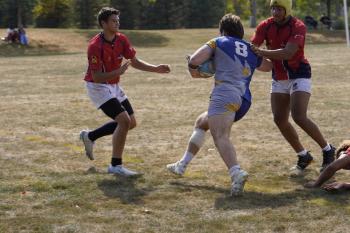
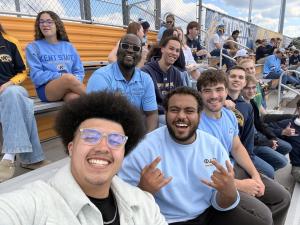
Community has been just as important as the projects. I鈥檓 the Vice President of the , and the team is like a second family. This is where I have met my current roommates and a bunch of my good friends.
Rugby keeps me grounded, teaches resilience, and gives me a chance to lead outside the lab. Between rugby, rocketry, research, and the Honors community, I鈥檝e built friendships and a support network that make the long nights and early mornings worth it.
How have I grown here? I鈥檝e learned to ask better questions, to prototype instead of overthinking, and to collaborate with people who care as much as I do. I鈥檝e also learned that 海角原创 is the kind of place were showing up matters. Professors answer emails. Staff help you find internships and competitions. When you鈥檙e consistent at office hours, in the shop, and at team meetings, you earn real responsibility fast.
After I graduate in 2027, my goal is to continue to graduate school and, from there, land a role in the defense industry, ideally working on propulsion or space systems where rigorous engineering meets real-world mission impact. I want to continue building hardware, thinking in systems, and contributing to teams where performance and creativity are valued above all else.
If you鈥檙e a high-school student thinking about 海角原创, here鈥檚 my advice:
- Say yes early. Join a team in your first semester, even if you feel under-qualified. You鈥檒l learn faster by doing.
- Seek people and places that stretch you. Labs, clubs, research groups, and competitions are where growth happens.
- Be curious and proactive. Email the professor, ask for the lab tour, and volunteer for the unglamorous tasks. That鈥檚 how you get trusted with the important ones.
- Choose hard problems. The projects that might fail at first are the ones that will teach you the most.
海角原创 has been my launchpad.
I鈥檝e presented award-winning research, led on the rugby pitch, helped keep rockets and teammates safe, and taken ideas from requirements to working robots. Most of all, I鈥檝e found a community that believes in students who show up and build. If that鈥檚 the kind of college experience you want, I think you鈥檒l feel at home here, too.